
Ultra-Processed Foods (UPFs) are everywhere, and often where you wouldn’t think to look. There’s the obvious – fizzy drinks, chicken nuggets, and the like – but you might not expect your fresh pot of hummus or your morning croissant to be harbouring sneaky ingredients. And surely basic ingredients are safe… right?
As Chris van Tulleken, author of Ultra-Processed People states, trying to avoid UPFs altogether is impossible. These days, there are more products with than without. There are serious health concerns associated with eating high quantities, but the odd UPF is okay, so don’t be too hard on yourself when you have the kind of day only a cheesecake can fix.
No particular UPF ingredient is terribly ‘bad’ in isolation or in small quantities, but we don’t know the full extent of what combinations of UPF ingredients might do to our bodies because these foods are relatively new, in the grand scheme of things. Scientists need to study the effects over years (ideally lifetimes), so good UPF research is only just starting to appear.
Here are some things to be aware of before your next shop.
Contents
- Ultra-processed ingredients to look out for
- 5 basic ingredients you didn’t know were UPFs
- Other highly processed staples
- Quick and simple recipes to switch to
UPF ingredients to look out for
The general rule of thumb is if you can’t find it in a kitchen, it’s a UPF ingredient. This isn’t strictly true, though – if your cereal contains zinc and iron supplements, that’s not a bad thing. I think it’s better to judge based on whether you recognise the words in the ingredients list. If it’s full of latinate, sciencey-looking terms, that’s a UPF.
I understand hesitation with topics that mess with our status quo, but we should know what we’re putting into our bodies and what potential harms they can cause. There are often alternatives to your favourite UPF products that taste just as good (if not better once you know it’s not full of crap), so you won’t lose much from having this awareness. Then once you’ve switched your staple buys, eating better takes no time at all.
Read on to learn more about what to look for, why these ingredients are used, and why they’re potentially harmful.
1. Flavourings
Examples: can be as specific as isoamyl acetate (banana flavour), or just simply say ‘flavouring’
Although some of these are harmless, they’re often an immediate signal that the product has a lack of natural flavour and/or nutrients. Flavouring is used to hide a UPF’s blandness – regardless of whether the flavouring is natural or artificial.
2. Synthetic emulsifiers
Examples: Lecithin, polysorbates, mono- and diglycerides of fatty acids
Emulsifiers are used to make foods creamy and to mix ingredients that don’t naturally blend, like oil and vinegar in your salad dressing.
Most of the harm emulsifiers cause can be attributed to changes in our microbiome. Our microbiomes are so complex that food regulators rarely study the effects products can have on it. Altering our microbiome can change our predisposition to different diseases, such as obesity and type 2 diabetes, as well as ‘leaky gut syndrome’.
There’s a really useful table in a paper on the National Library of Medicine journal, explaining which emulsifiers have produced the most negative effects on the microbiome within the available research. For example, Lecithin naturally occurs in egg yolk, soy and sunflowers, and thus is generally considered alright, however it’s still often a signal that the product you’re holding is UPF.
3. Stabilising gums
Examples: carrageenan, carboxymethylcellulose, guar gum, xanthan gum, locust bean gum
Gums are used to thicken, stabilise and extend the shelf life of foods. They’re often found in dairy products, desserts, ice cream, baked goods, and ‘low fat’ foods. Low fat is potentially more harmful for you than full fat items, as you’re usually replacing natural fats with nutrition-less gums.
Some gums (like xanthan) may be naturally derived, but the health effects seem mixed. Some claim it can lower cholesterol and blood sugar, but also that it can cause respiratory and digestive issues. The fact it’s also used to thicken wallpaper paste, shampoo, and much more, is a little offputting.
Xanthan gum is also the food of a new bacterial species that now lives in billions of people. This bacteria is completely absent from populations that don’t eat UPFs. This may also invite a second species that eats the breakdown products of the first one, and so on, until you have your typical ‘there was an old lady who swallowed a fly’ situation. We currently don’t have enough research on what harm these new bacteria may cause us.
4. Artificial sweeteners
Examples: cyclamate, aspartame, saccharin
Usually found in fizzy drinks, packaged snacks, reduced sugar items, and more, but they can even be found in non-food items like toothpastes and medications.
Studies show artificial sweeteners are linked to weight gain and diabetes, and that a mix of sugars and sweeteners decrease a healthy person’s response to insulin akin to type 2 diabetes.
5. Firming or bulking agents
Examples: maltodextrin, polydextrose, modified starch
These ingredients are used to make products more addictive and/or to make a product cheaper to make by adding more volume to a food. They usually replace fats or dairy ingredients, which are notoriously more expensive, and shorter life.
This also means they appear in many low-fat and low-sugar ingredient lists. But if your food isn’t providing the nutrients you need, it’ll be unfulfilled and tell you it needs more food, so this naturally fuels issues with obesity and diabetes. Bulking agents mess with the texture too, making it easy to overeat. They can also cause digestive issues, and disrupt the microbiome like emulsifiers do.
6. Nitrites and nitrates
Examples: potassium nitrite, potassium nitrate, sodium nitrite, sodium nitrate
These ingredients are most commonly used to make pork look pink instead of its natural grey. Yet recent research has shown a link between the quantity of nitrites/nitrates consumed and an increased risk of cancer.
Yep. They increased our risk of cancer for market appeal.
However, this is a great example of public buying power. People don’t want carcinogenic bacon, and supermarkets are having to react to this ‘trend’. Supermarkets like Tesco have finally started listening and are not only stocking better brands (like Finnebrogue, who use beetroot extract to get that reddish colour), but are also creating an own-brand product (likely inspired by M&S’s popular minimal ingredient line). Now you can get sausages, bacon (and in some places lardons and ham) that are nitrite-free. This is a USP, so it’ll state it loud and clear on the front of the pack.
In terms of cured meats, it’s currently a real mixed bag. We’ve found that chorizo rings, prosciutto and serrano ham are largely okay (ingredients are just ‘pork and salt’), but it very much depends where you get it from. Items like sliced chorizo or salami, however, are basically never nitrite free.
This isn’t an extensive list of UPF ingredients, but it covers the main categories. If you’re ever unsure about an ingredient, look it up and make a note in your phone to refer back to. Check out Holland & Barrett’s glossary as a quick guide on UPF terminology.
Five basic ingredients you didn’t know were UPF (and totally don’t need to be)
Sorry if you also end up glaring at these inanimate supermarket shelves as I now do. But for each product I shun below, I’ve provided alternative brands that are generally better:
1. Stock cubes and gravy granules
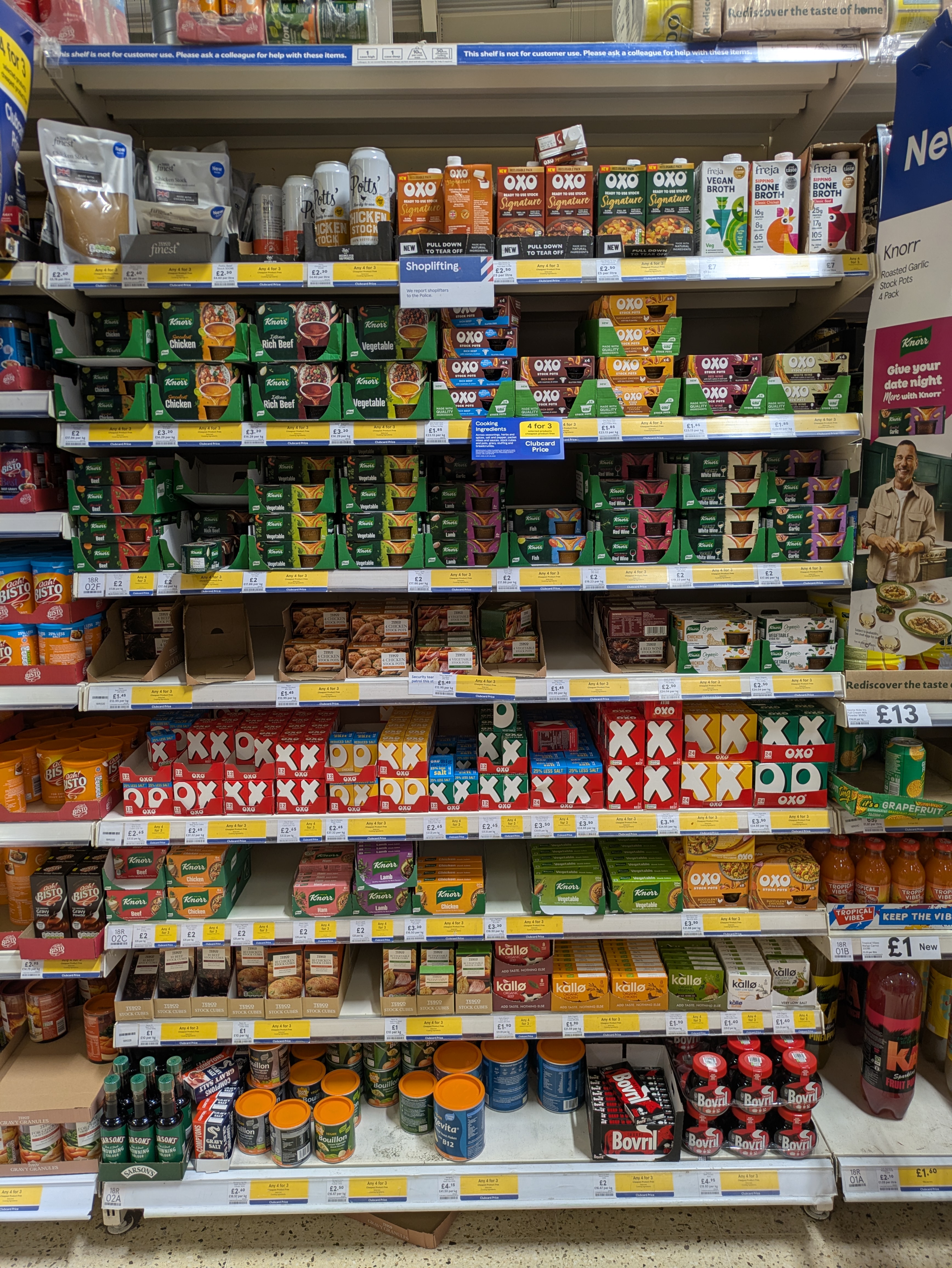
This one really upset me. Our local Tesco had maybe forty different types and brands of stock and gravy granules. Guess how many of them have no UPF ingredients?
One. Vegetable bouillon.
We’ve cooked with stock for so long, thinking we were cooking healthy and nutritious meals without knowing this little ‘flavour bomb’ contains a load of shit. I should never have trusted those gunky wibbly cubes. Half of them have barely even brushed past the meat they advertise on the box.
- Often contains: dextrose, maltodextrin, flavourings, stabilisers like Tara Gum, xantham gum, or locust bean gum, monosodium glutamate, soya lecithin, colourings like ammonia caramel, potassium chloride, palm fat, palm oil, added salt and sugar.
- Alternative brands:
- M&S concentrated stock: chicken extract (chicken, chicken bones, chicken fat), water, salt, yeast extract, chicory fibre, cornflour, sugar. Beef stock also available.
- bouillon powder (Dr Coy’s is good, but quite hard to get in the UK. We use Marigold veg bouillon, available in our local Tesco Extra).
2. Soy sauce
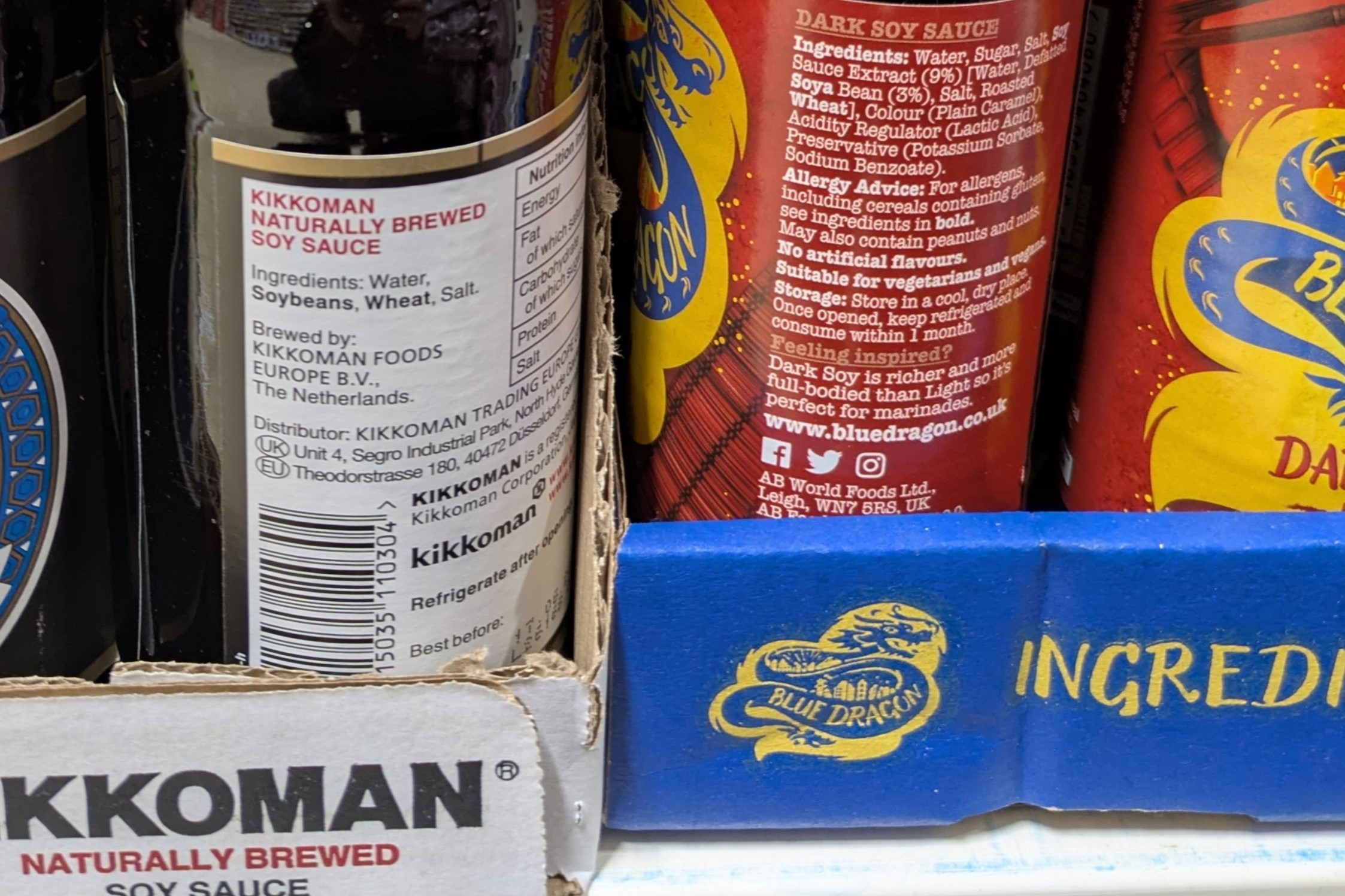
I’d wrongly assumed this was just soy. But take a look at your average bottle of supermarket soy sauce, and you’ll find it may contain as little as ‘10% soy sauce extract’. The rest is all water, salt, and caramel syrup for the colour.
- Often contains: caramelised sugar syrup, preservatives like potassium sorbate, added sugar and salt.
- Alternative brands:
- Kikkoman (available in Tesco and most Asian supermarkets): water, soybeans, wheat, salt.
- Lee Kum Kee (available in Sainsbury’s) is also better, but contains added sugar.
3. Bottled lemon and lime juice
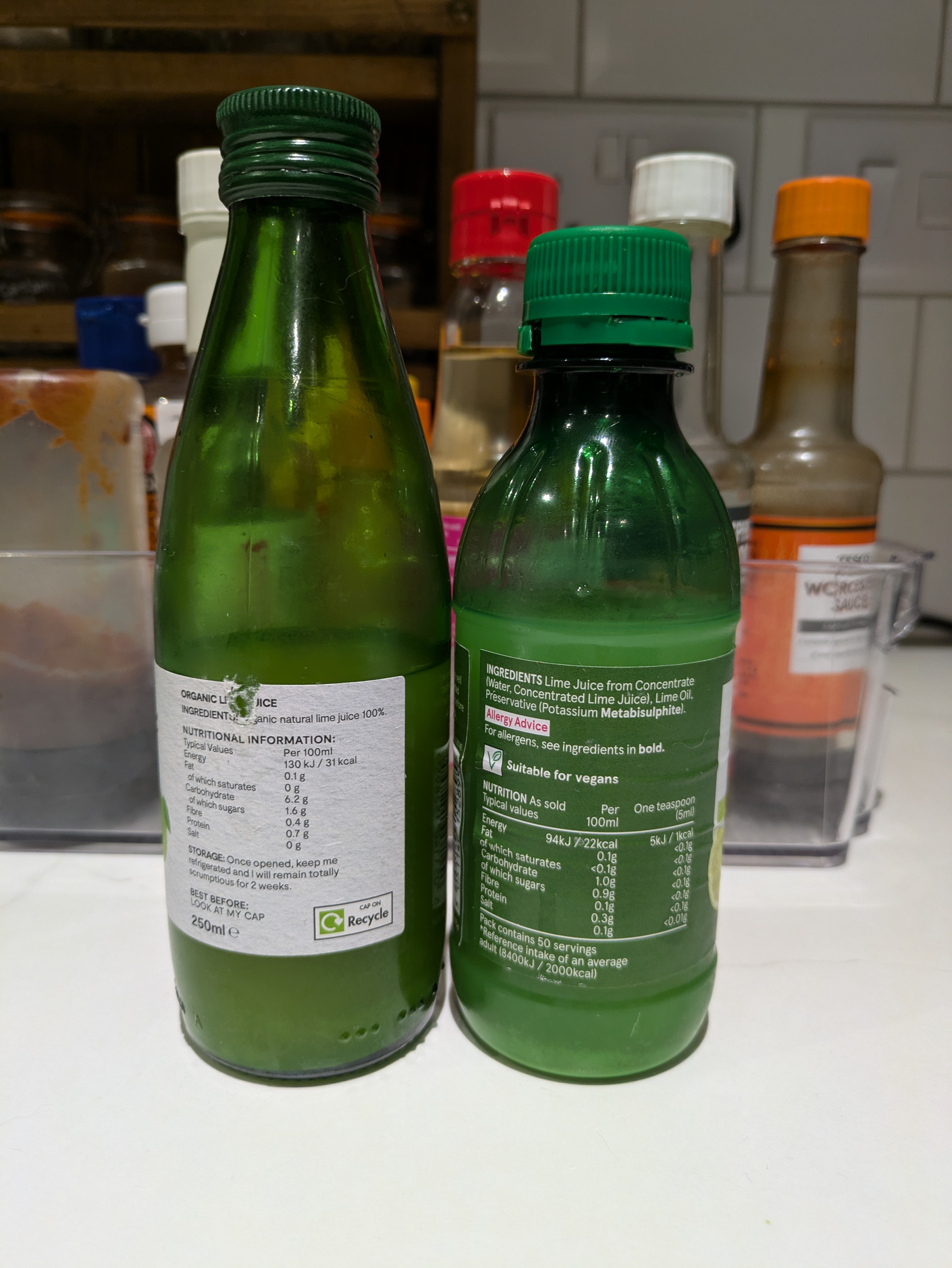
Imagine my surprise when I found out lemon juice isn’t just lemon juice. It makes sense when you think about it – fruit goes off pretty quickly, so how does lemon juice survive on the shelf for so long? But these are just things that have become the norm. We don’t always know to question it.
- Often contains: potassium metabisulphite (E224), added water (not bad for you, just bad value)
- Alternative brands:
- Mr Organic lemon juice and lime juice (available from Ocado)
- Biona Organic lemon juice (available from Waitrose). Contain 100% lemon/lime juice.
4. Plant-based milk
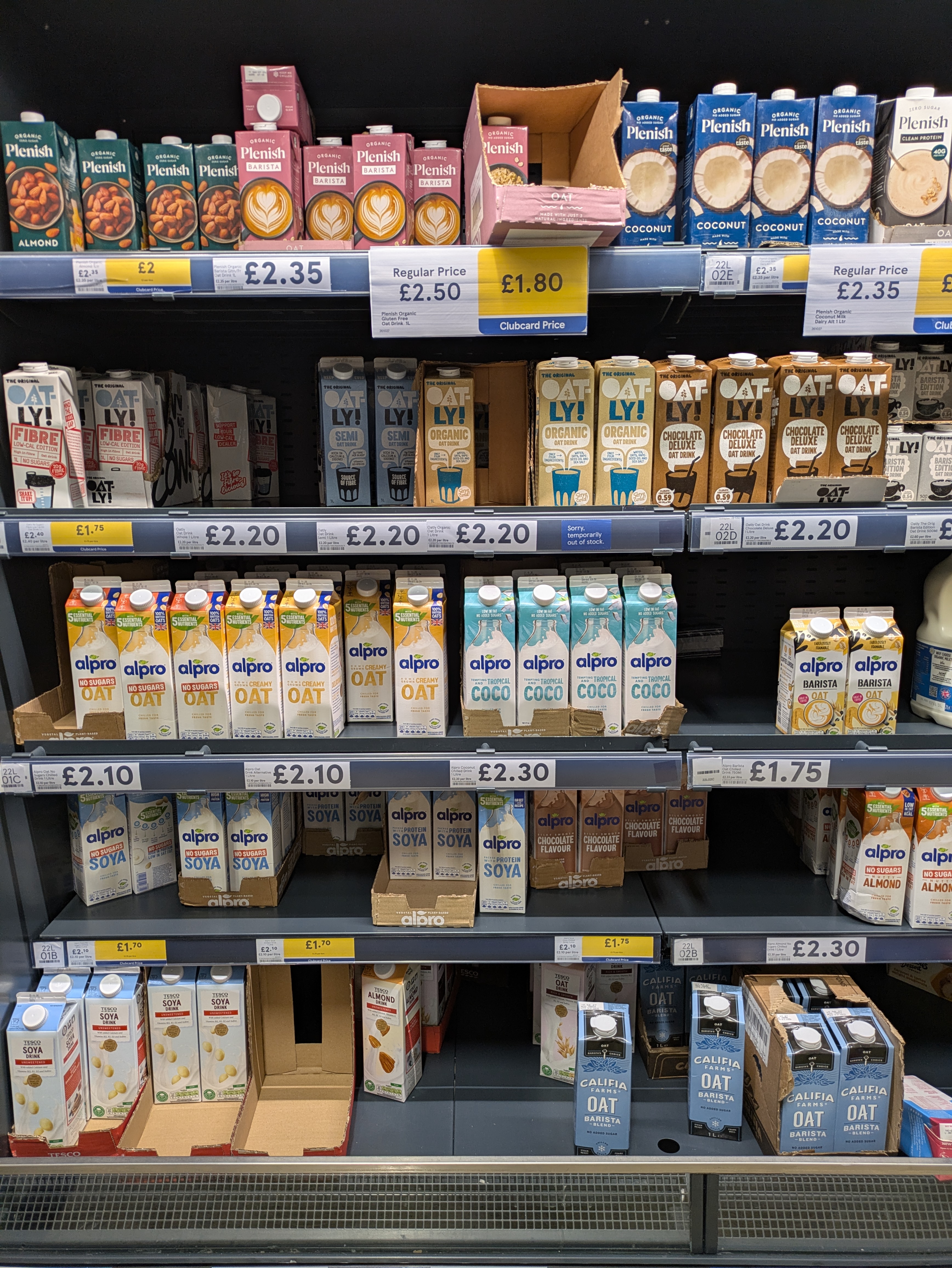
Even products posed as ‘better for the planet’ often contain UPFs – particularly vegan meats as you’d expect, but also some dairy-free milk brands. Unfortunately, as with many UPFs, you have to look to the premium prices for those with the fewest ingredients.
- Often contains: potassium carbonate or dipotassium phosphate, calcium carbonate, tricalcium phosphate, maltodextrin, potassium iodide, and stabilisers like Gellan Gum.
- Alternative brands:
- Plenish (available from Tesco): water, oats, sea salt.
- Rude Health (available from Tesco): water, oats, cold-pressed sunflower oil, sea salt.
5. Cream cheese
This is my most recent frustrating discovery. Luckily, my partner is also now in the habit of checking ingredient lists, and one of his biggest UPF sadnesses is the lack of cheesecake, so I thought I’d make one for him. It was fortunate that before we put four tubs of cream cheese through the Aldi self-service that he thought to check the back of a pack.
Absolutely packed full of gums.
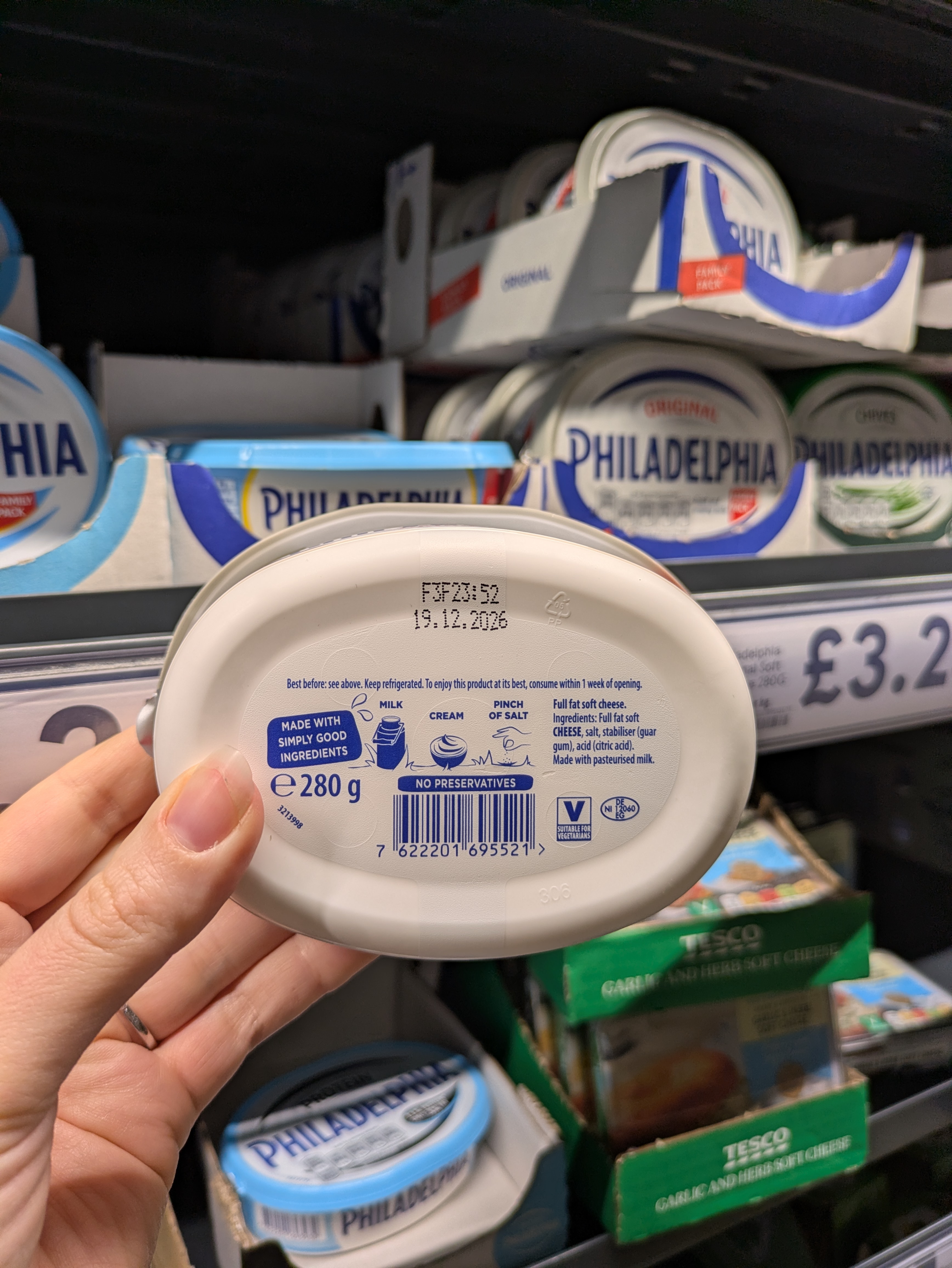
It hadn’t even crossed my mind that cream cheese would be anything other than cream cheese. We held off until Tesco, where we found that Philadelphia, despite being the premium brand, still contains guar gum and added salt and acid. It even states on the tub ‘made with simply good ingredients’. I guess ‘good’ isn’t something you can quantify in legal terms, but it still feels icky.
Luckily, Tesco’s own brand is not only cheaper, but just 100% cheese.
- Often contains: guar gum and other gums, carrageenan, added salt (including Philadelphia and Aldi’s own brand).
- Alternative brands: Tesco’s soft cheese, Sainsbury’s soft cheese – both ingredient lists state only ‘full fat soft cheese (cows’ milk)’.
Other products with UPF ingredients to look out for
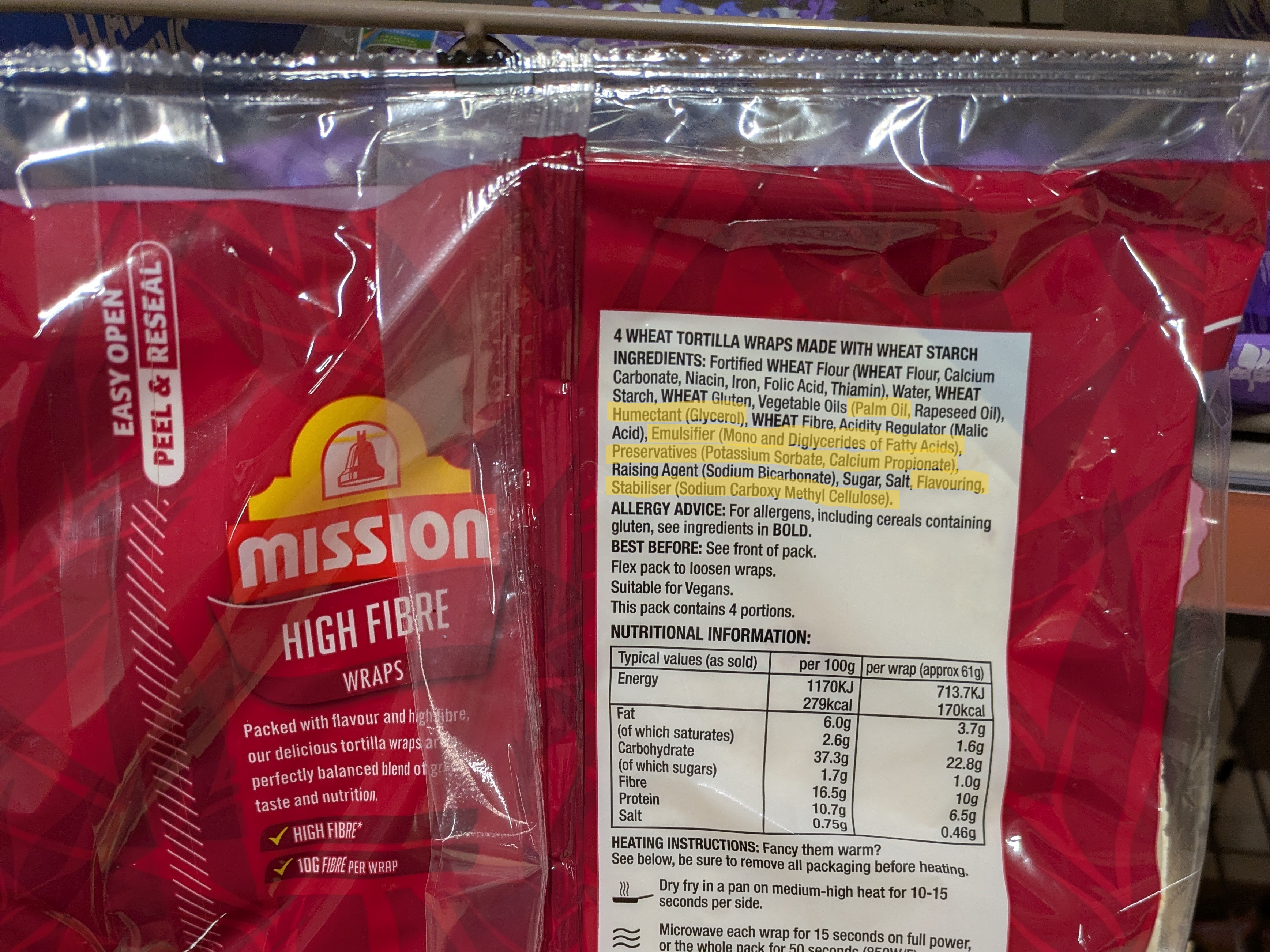
- Wraps, breads, and other supermarket bakery items (yep, even the ‘fresh’ ones). Deli Kitchen and Crosta Mollica are quite good for wraps and bread alternatives.
- Condiments, dips, and sauces. Some are better than others, like Hellman’s being one of the better ketchups.
- ‘Low-fat’ dairy products like yoghurts. As mentioned above, these often replace natural fats with UPF ingredients – which have been strongly linked to weight gain and diet-related diseases.
- Long-life variations of products like Elmlea. I grew up with this stuff and never questioned why it lasted so much longer than normal cream. It doesn’t even taste like cream!
- Cured pig products – sliced ham, bacon, sausages and continental meats. The vast majority contain sodium nitrite or nitrate – a direct link to cancer that is used simply to make the meat look pink.
Quick and simple recipes to replace UPFs
As you’d expect, it’s usually best if you have the time, money, and inclination, to make whatever you can from scratch. That way you know exactly what’s gone into your food and you can control the amount of salt, fat and sugar. Of course, that’s not always possible, but here are some quick recipes I’ve enjoyed making, should you find yourself free and willing:
- Gu pot mousse alternative (with 2 ingredients!) Good for using up eggs.
- Granola bars: yep, even ‘healthy’ snacks contain UPFs. In this recipe, I usually swap the cranberries for sultanas and walnuts for a more exciting nut like pecans.
- Porridge:
Don’t buy those little takeaway pots! All you need are oats, milk and your flavour of choice. It’s barely any slower to make!
1/3 cup of oats to 2/3 cup of milk. Add your own flavouring, such as cinnamon, or golden syrup. Microwave for two mins, or for longer to your preferred consistency. Stir halfway through. Top with demerara (always). - Gravy:
Make a roux and add the concentrated stock mentioned above, then add water to get to your preferred consistency. You can also add onion granules and a splash of red wine vinegar to add depth of flavour. - Tortilla wraps: really tasty and avoids A LOT of extra unnecessary ingredients that shop-bought ones are made with (they’re just flour, oil, salt and water). A bit more of a faff than the other recipes if you need them in a pinch, but you can freeze them.
If you’ve found any other infuriating products containing UPF ingredients that shouldn’t, or you have some savvy recipes to share, drop them in the comments below!

